

SMO#3 : Analyse récursive des dépendances
____
private
List<TablePath> lookForChilds( TablePath root , TablePath parent)
{
List<TablePath> ltp = new List<TablePath>();
DataTable dt = _database.Tables[parent.TableName,parent.Schema].EnumForeignKeys();
foreach (DataRow dr in dt.Rows)
{
string tableName = dr[1].ToString();
string schemaName = dr[0].ToString();
string fkname = dr[2].ToString();
if (!(tableName.Equals(parent.TableName) &&
schemaName.Equals(parent.Schema))
)
{
____
Je teste le parent afin de ne pas partir en récursion infinie liée à un éventuel Parent-Chlid ou association :
____
log.Info(
"scanning now " + tableName);
TablePath tp = new TablePath();
tp._database = parent._database;
tp._server = parent._server;
tp.TableName = dr[1].ToString();
tp.Schema = schemaName;
tp.ForeignKey = fkname;
tp._childs =
this.lookForChilds(root, tp);
ltp.Add(tp);
}
else
{
log.Info(
"preventing infiniteRecursion on " + tableName);
}
}
return ltp;
}
____
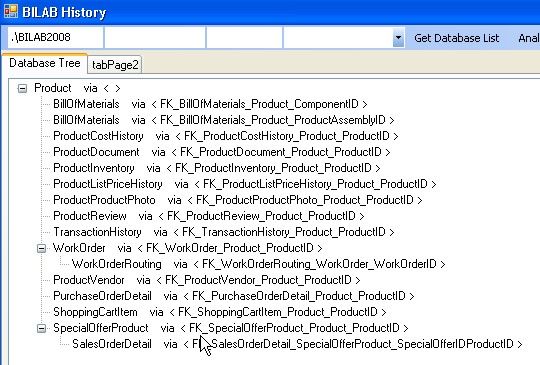
En passant, nous remplissons la ForeignKey impliquée. L'ensemble se restitue toujours avec la méthode AdaptTablePath() :
____
private void AdaptTablePath(ref TreeNode node, TablePath tablePath)
{
node.Text = tablePath.TableName +
" via < " +tablePath.ForeignKey +" >";
if (tablePath.Childs != null)
{
foreach (TablePath tp in tablePath.Childs)
{
TreeNode childNode = new TreeNode(tp.TableName );
AdaptTablePath(
ref childNode, tp);
node.Nodes.Add(childNode);
}
}
}
____
En mode restitué :
____
____